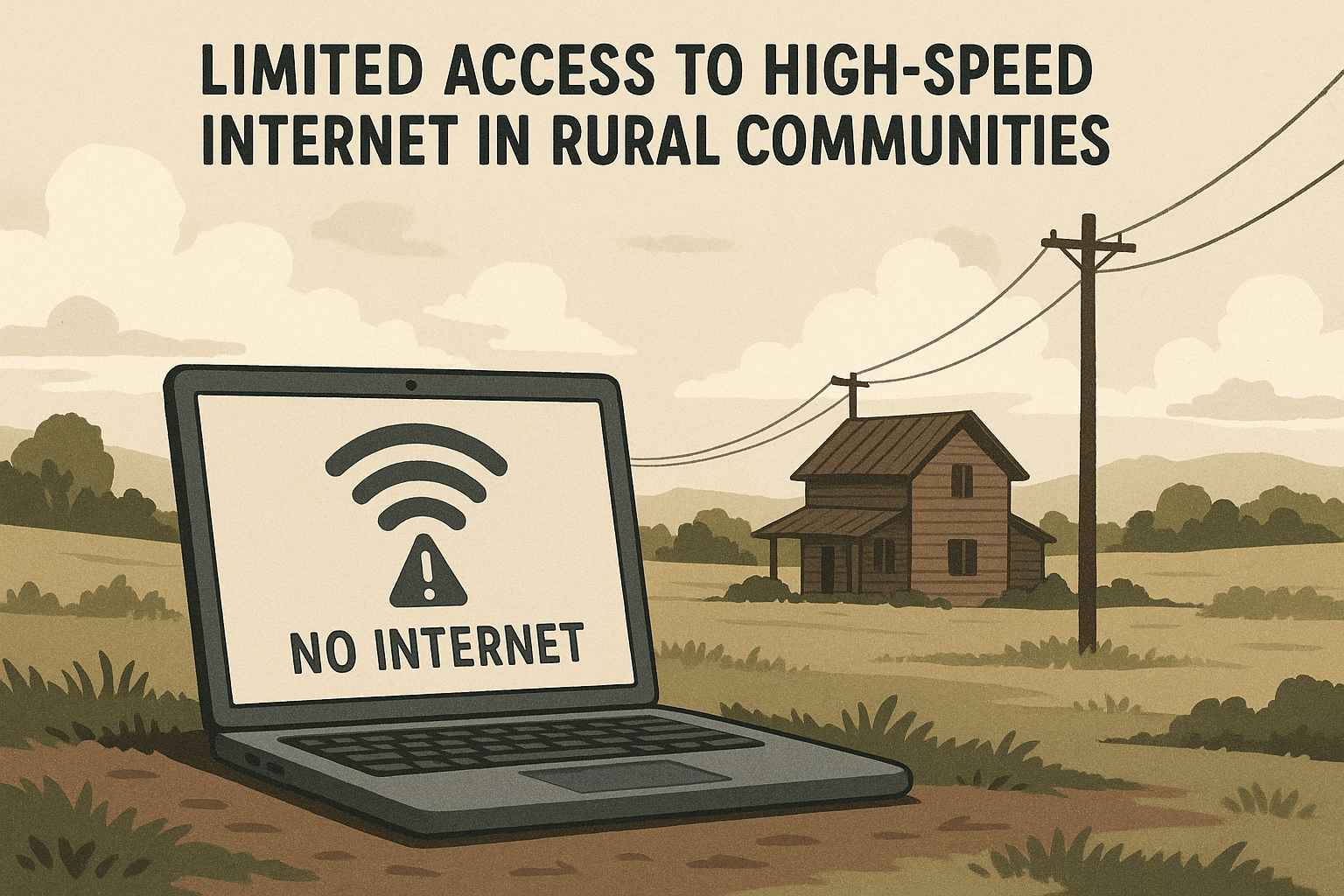
When Americans think about infrastructure, they picture concrete and steel: highways, bridges, water pipes, power lines. These physical systems remain critically important, but there’s another infrastructure crisis unfolding that’s equally consequential for the nation’s future—the digital divide.
Millions of Americans still lack access to reliable high-speed internet. In an economy where remote work, online education, telemedicine, and digital commerce have become essential rather than optional, this isn’t a luxury problem. It’s an infrastructure deficit as serious as a collapsed bridge or contaminated water supply, and addressing it will require investments measured in hundreds of billions of dollars. That’s
The Scale of the Problem
Approximately 19 million Americans lack access to broadband internet meeting minimum standards for modern use. That’s roughly the population of New York State without reliable connectivity. The problem is particularly acute in rural areas, where 25% of residents lack broadband access compared to just 2% in urban areas.
But the digital divide isn’t just about access—it’s about quality and affordability. Many Americans have theoretical access to broadband but can’t afford service, with monthly costs ranging from $50 to $100 or more. Others have access only to slower connections inadequate for video conferencing, online learning, or running a home business. And even some areas with broadband infrastructure face reliability issues, with frequent outages that make the connection essentially unusable.
The economic consequences are staggering. Studies estimate that lack of broadband access costs the U.S. economy $140 billion annually in lost productivity, missed educational opportunities, reduced healthcare efficiency, and diminished quality of life. That’s economic output vanishing simply because the digital infrastructure doesn’t exist to support it. That’s why private equity companies, like American Infrastructure Partners, are working to increase digital infrastructure across the country.
Why Markets Failed to Solve This
If broadband is so economically important, why hasn’t the private market provided it? The answer lies in the economics of rural infrastructure, which parallel historical challenges with electrification and telephone service.
In urban and suburban areas, high population density makes broadband profitable. A single fiber optic line can serve hundreds of households in a small geographic area, generating revenue that far exceeds installation costs. Rural areas face the opposite math: installing miles of fiber to serve a handful of households costs hundreds of thousands of dollars with minimal revenue potential.
Internet service providers naturally focus on profitable urban and suburban markets, leaving rural areas underserved. This is rational business behavior but creates the same market failure that required rural electrification programs in the 1930s. Without public intervention, rural areas simply won’t get built out because the return on investment doesn’t justify the capital required.
The Education Crisis
The COVID-19 pandemic exposed the stakes of the digital divide with brutal clarity. When schools shifted to remote learning, millions of students lacked home internet access sufficient for online classes. Students parked in fast-food restaurant parking lots to use WiFi for homework. Families shared a single connection among multiple children and working parents. Teachers struggled to reach students who simply disappeared from virtual classrooms.
The learning loss was severe and disproportionate. Students in well-connected households maintained educational progress while those without adequate internet fell behind—sometimes far behind. This isn’t about students lacking motivation; it’s about infrastructure inequality creating educational inequality.
The problem persists beyond pandemic emergencies. Modern education increasingly depends on internet access for research, assignment submission, and supplementary learning. Students without home broadband are at significant disadvantages even when schools are physically open. They can’t easily complete homework, access online tutoring, or develop digital literacy skills their peers take for granted.
This infrastructure deficit is creating generational consequences. Students who fall behind academically are less likely to pursue higher education, earn lower lifetime incomes, and face diminished economic prospects. The digital divide is becoming an economic mobility divide with implications lasting decades.
The Healthcare Dimension
Telemedicine has transformed healthcare delivery, allowing rural residents to access specialists without traveling hours, enabling elderly patients to manage chronic conditions from home, and providing mental health services in areas with severe provider shortages. But telemedicine requires reliable broadband—and many who could benefit most lack access.
Rural areas generally face the most severe healthcare access challenges, with fewer doctors, greater distances to hospitals, and older populations with more healthcare needs. These are precisely the communities where telemedicine could make the biggest difference, yet they’re also the communities least likely to have broadband infrastructure supporting it.
The irony is painful: the technology exists to address rural healthcare challenges, but the infrastructure to deliver that technology doesn’t. Patients who could avoid expensive emergency room visits through remote monitoring can’t because their internet connection is too slow or unreliable. Doctors who could treat patients remotely can’t because video visits require bandwidth those patients don’t have.
Healthcare costs rise while outcomes suffer, all because digital infrastructure lags decades behind medical technology.
The Economic Development Imperative
Broadband access has become essential for economic opportunity. Remote work allows people to live in affordable areas while earning urban salaries—but only if those areas have reliable internet. Small businesses depend on e-commerce, digital marketing, and cloud-based tools—capabilities requiring robust connectivity. Entrepreneurs can launch startups from anywhere—if bandwidth supports it.
Communities without broadband face economic stagnation. Young people leave for connected areas. Businesses won’t locate where internet is inadequate. Home values stagnate while connected communities see appreciation. The digital divide becomes an economic development divide, with connectivity determining prosperity.
Some rural communities have recognized this and taken action. Municipal broadband networks, electric cooperatives entering the internet business, and local governments subsidizing private buildout all represent attempts to solve the problem locally. Success varies, but the common thread is recognizing that broadband is infrastructure requiring public intervention, not just a private service that markets will eventually provide.
The Technology Choices
Building out digital infrastructure requires choosing among technologies with different characteristics, costs, and capabilities. Fiber optic cable provides the highest speeds and capacity but costs the most to install, particularly for improving internet access in rural areas. Fixed wireless solutions cost less to deploy but offer lower speeds and less reliability. Satellite internet can reach anywhere but historically suffered from high latency and data caps, though newer systems like Starlink show improvement.
The optimal technology varies by geography and need. Dense suburban areas justify fiber investment. Rural areas with moderate density might use fixed wireless. Remote locations may need satellite as the only viable option. But deploying multiple technologies requires coordination and planning—exactly the kind of infrastructure policy expertise that states and the federal government should provide.
Some policymakers favor technology-neutral subsidies that let providers choose deployment methods. Others prefer focusing subsidies on fiber as the most future-proof technology. The debate matters because today’s choices will shape digital infrastructure for decades.
The 5G Question
Fifth-generation wireless technology (5G) promises transformative capabilities: faster speeds, lower latency, and capacity to support massive numbers of connected devices. Autonomous vehicles, smart cities, advanced manufacturing, and countless other applications depend on 5G infrastructure.
But 5G deployment faces its own infrastructure challenges. The technology requires much denser networks of cell towers and fiber backhaul than previous wireless generations. In cities, carriers must install thousands of small cells on light poles, buildings, and other structures. Rural 5G faces even steeper economics than rural broadband, with limited business case for private investment.
Furthermore, 5G isn’t a substitute for wireline broadband—it’s complementary. The wireless infrastructure itself depends on extensive fiber networks. Building comprehensive 5G coverage requires solving the same rural connectivity challenges that plague traditional broadband while adding new technical complexity.
America’s 5G deployment has progressed in urban areas but lags in rural regions, creating another layer of digital divide. The infrastructure challenge isn’t just connecting homes; it’s building the networks that will support the next generation of digital economy.
Cybersecurity as Infrastructure
Digital infrastructure isn’t just about access—it’s about security. Cyberattacks on infrastructure have escalated from theoretical concerns to clear and present dangers. Colonial Pipeline, water treatment facilities, hospitals, and government agencies have all suffered serious attacks that disrupted services and threatened public safety.
Cybersecurity infrastructure requires investments in monitoring systems, rapid response capabilities, redundant systems, and workforce training. Unlike physical infrastructure that typically fails gradually, digital systems can fail catastrophically and instantly. A successful attack on electrical grid controls, water treatment systems, or transportation networks could have devastating consequences.
Yet cybersecurity receives a fraction of the attention and investment directed toward physical infrastructure. The consequences of this neglect may be less visible than potholes but potentially far more serious. Building resilient digital infrastructure requires treating cybersecurity as a foundational element, not an afterthought.
Privacy and Data Protection
As infrastructure becomes increasingly digital—smart traffic management, automated water systems, connected vehicles—massive amounts of data are generated about people’s movements, behaviors, and activities. This data enables system optimization and service improvements but also creates privacy concerns and security vulnerabilities.
Infrastructure policy must address data governance: who owns infrastructure-generated data, how it can be used, what protections exist, and how long it’s retained. These aren’t just technical questions; they’re fundamental policy choices about the kind of digital infrastructure society wants to build.
Europe has moved aggressively on data protection with regulations like GDPR. America has taken a more fragmented approach, with different rules in different states and sectors. As digital infrastructure expands, coherent data protection policies become more urgent to maintain public trust and prevent abuse.
The Path Forward
Addressing America’s digital infrastructure deficit requires sustained investment measured in hundreds of billions of dollars. Recent federal legislation has directed significant funding toward broadband expansion, but implementation challenges remain. Building rural networks is technically and logistically complex. Ensuring competitive markets while subsidizing deployment requires careful policy design. Coordinating federal, state, and private investments demands unprecedented cooperation.
The good news is that America has solved analogous problems before. Rural electrification in the 1930s brought power to farms and small towns through government-supported cooperatives. The Interstate Highway System connected the nation through federal planning and investment. The question isn’t whether government should play a role in digital infrastructure; it’s what role will be most effective.
Success requires treating broadband as essential infrastructure rather than a luxury service, maintaining sustained investment over years rather than one-time infusions, ensuring affordability alongside availability, and planning for future technologies rather than just solving today’s gaps.
The digital divide isn’t a problem that will solve itself. Like crumbling roads and aging water systems, it requires recognition that some infrastructure needs public investment to exist at all. The difference is that every year without action widens inequality, reduces economic growth, and leaves more Americans disconnected from opportunity.
The choice is clear: invest in digital infrastructure as seriously as bridges and roads, or accept a divided nation where opportunity depends on the accident of geography. That’s not a choice America can afford to defer.